
Commissioning a film
Spec ad or commissioned campaign? How to read an (AI) ad portfolio
A spec ad is an advertising film made without a commission from the brand it features: the studio picks the product, writes the idea and produces the film to show what it can do. A commissioned campaign answers a brief from an advertiser or its agency, with a budget, approval rounds and media placement decided by the brand. On screen, the two can look identical. So when you read a portfolio, look for what the logo cannot tell you: the film’s status, the studio’s contribution and what the images actually show.
In this guide
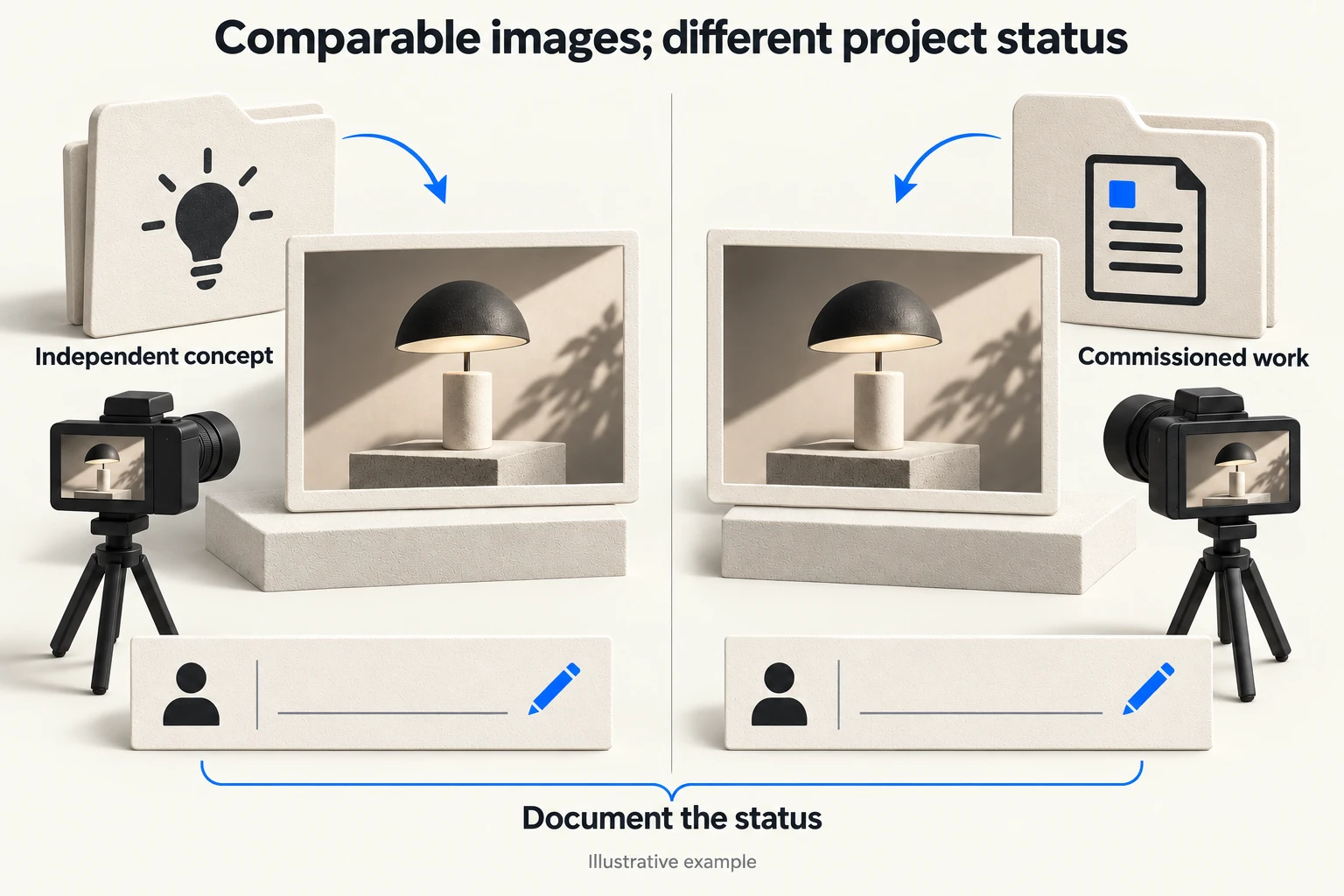
- INDEPENDENT CONCEPT COMMISSIONED WORK
- Exploration initiated by the creator A real commission to document
- Role: specify the contribution Role: specify the contribution
- A visible brand does not establish a client relationship.
- Fictional lamps; neither frame represents an actual commission.
Generated teaching maquette · Fictional example. Shapes and relationships illustrate the principle; they are not an optical simulation or a product test.
Every film PIRAXE shows is a spec ad. Uniqlo, Nothing, Terre d’Hermès, illy, JBL, Bleu de Chanel, Nike: none of these brands commissioned a film from us, and none is a partner of the studio. Here is how we label that, and how to read this kind of portfolio, ours or anyone else’s.
What is a spec ad?
“Spec” is short for speculative. Doing something on spec means doing it without being asked, betting that it will pay off later; Oxford Learner’s Dictionaries traces the phrase back to speculation. In advertising, a spec ad is a film built freely around a brand that nobody paid for and the brand never approved. Directors use spec ads to show their eye. Studios use them to show their method.
A spec ad proves that someone can find an idea, direct the camera, choose takes, edit and finish a film. It says nothing about holding a budget, getting through a brand’s approval process or working inside imposed guidelines. It says nothing about sales either: until a campaign has run it, there are no results to quote.
How PIRAXE labels its films
A status label only works if it travels with the film. On our site it appears at four levels:
- in the film itself: Earth / Light, our 18-second film for Terre d’Hermès, closes on a clear product shot with the PIRAXE signature and a SPEC AD label;
- under the title of each project page: “Independent concept ad”;
- in the credits: “An independent demonstration film (spec ad). This film was not commissioned by, or produced in partnership with Terre d’Hermès.”;
- in the legal notice: “The films are independent advertising concepts. They are not client commissions, brand partnerships or endorsements by the featured brands.”
A title can mislead too. Blue Hour is the title of our film for Bleu de Chanel, not the name of a new fragrance. Our project notes say so, and describe the film as “a personal spec ad”.
Then there is the status of the file itself, which people tend to forget. A portfolio mixes finished films, explorations and working takes. Ours does too:
| Film | What the file shown is | What you can judge from it |
|---|---|---|
| Le confort a de la tenue (Uniqlo) | A 27-second edited film, with its twist and a product shot | The idea, the pacing, the ending |
| Le son en lumière (JBL) | A portrait exploration of about 30 seconds | Material, light, changes of scale |
| Blue Hour (Bleu de Chanel) | An original take of about 30 seconds, kept as an exploration | Framing, contrast, the bottle’s position |
For Blue Hour, our study page compares a composition reference with a frame taken at 00:24.4 and states that it “is not presented as a finished master”. Judging that shot as a delivered film would be a misreading, and it is the studio’s job to make sure nobody has to guess.
Check the contribution before crediting the work
Films often have several authors. For group work, ScreenSkills advises being clear about your contribution in a portfolio, sometimes with nothing more than a line of text on the image. The advice is written for animation artists. It applies to any studio.
Ask what the studio actually did: the idea, the images, the edit, the sound, the adaptation. Take Le monde baisse, our 30-second film for Nothing. The idea, art direction, images and edit are PIRAXE’s. The music is not: it is Twilight Echo by Scott Buckley, licensed under CC BY 4.0, in its No Synth Lead version, adapted for the edit. The credit on the film page says so, which is exactly what a project card should do.
For commissioned work, also separate the direct client from the visible brand. A studio may work for an agency, or handle only part of a production. A good project card says so in one sentence.
What an AI spec ad shows, and what it doesn’t
In an AI-produced film, the question “who did what?” shifts. The images come out of generation tools, and our credits say so: “Imagery and visual production by PIRAXE using AI creative tools.” What you are judging is the decisions: the idea, the story, the camera direction, shot selection, editing and finishing. That is where the film gets made.
Then look at the product and compare it with its official photo: shape, label, materials, details. On a PIRAXE commission, the product starts from its official photos, the AI never redraws it, and a visual effect must never invent a property of the product. An AI disclosure is part of the deliverables.
What an AI spec ad cannot show is how the studio handles your deadlines, your feedback or your mandatory wording. You check those in the conversation and the proposal, not in the film.
Brands in a spec ad: tread carefully
By definition, a spec ad shows a brand that did not commission it: its name, its product, sometimes its logo. Those remain subject to their owners’ rights. That is why the status label has to follow the film wherever it goes, so nobody mistakes it for an official campaign or a partnership. Our legal notice puts it this way: “A brand name identifies the subject of a concept.”
How far that use can go depends on the country and the channel. Showing a film in a portfolio is not the same as buying media to run it. This guide is not legal advice: before you distribute a spec ad beyond a portfolio, have a lawyer review that use.
A transparent project card: the Earth / Light example
Here is our project card for Earth / Light, condensed:
Terre d’Hermès, Earth / Light. An independent creation, not commissioned by Hermès. Challenge: connect the bottle to a mineral landscape through light, glass and material. Choices: contrast raw rock with precise reflections in glass and metal; reveal the bottle behind a rock, then vary scale and viewpoint; close on a clear product shot with the PIRAXE signature and SPEC AD label. Delivery: an 18-second portrait film in 9:16, with a soundtrack, closing signature and a cover frame taken from the edit.
You can check every sentence in the film. “Reveal the bottle behind a rock”: watch the shot and decide. A line like “the campaign transformed brand perception” would need data a spec ad does not have, because no campaign ever ran. The card names no client, budget or result, because there are none.
Turn a selection into a concrete discussion
To connect a portfolio with your brief, pick one passage and say what interests you. “The foreground rock places the bottle within a textured setting” points towards a visual-production request. “The backdrop rises on her living room”, the twist in our film Le confort a de la tenue, belongs to concept development. Then ask what would change with your product, your audience and your official photos.
Bring your constraints: fidelity to the model you sell, the deliverables you expect, an idea already written or one still to find. The portfolio then becomes the starting point for a discussion about your project, with references whose status is clear.
Describe your creation project with the examples that interest you and the qualities you want to explore.
Guide prepared by PIRAXE with the help of AI tools, based on the sources cited. Examples are illustrative, not client results.