


Commissioning a film
How to write a creative brief for a video: goal, message, deliverable
Learning how to write a creative brief for a video starts with three decisions people often blur together: the goal, the message and the deliverable. A creative brief is the document that tells the creative team what a film must achieve, what it must get across, to whom, and in what form it will be delivered. The goal describes what the brand wants to change. The message states what the audience should understand. The deliverable is what the studio must hand over. Keep them apart: a file format does not define an idea, and a commercial intention does not yet describe what appears on screen.
In this guide
Shopify’s creative brief guide describes the brief as “a sharp, focused document that outlines the objectives, success metrics, key messages” and lists goals separately from project requirements. We apply the same separation when a film is commissioned.
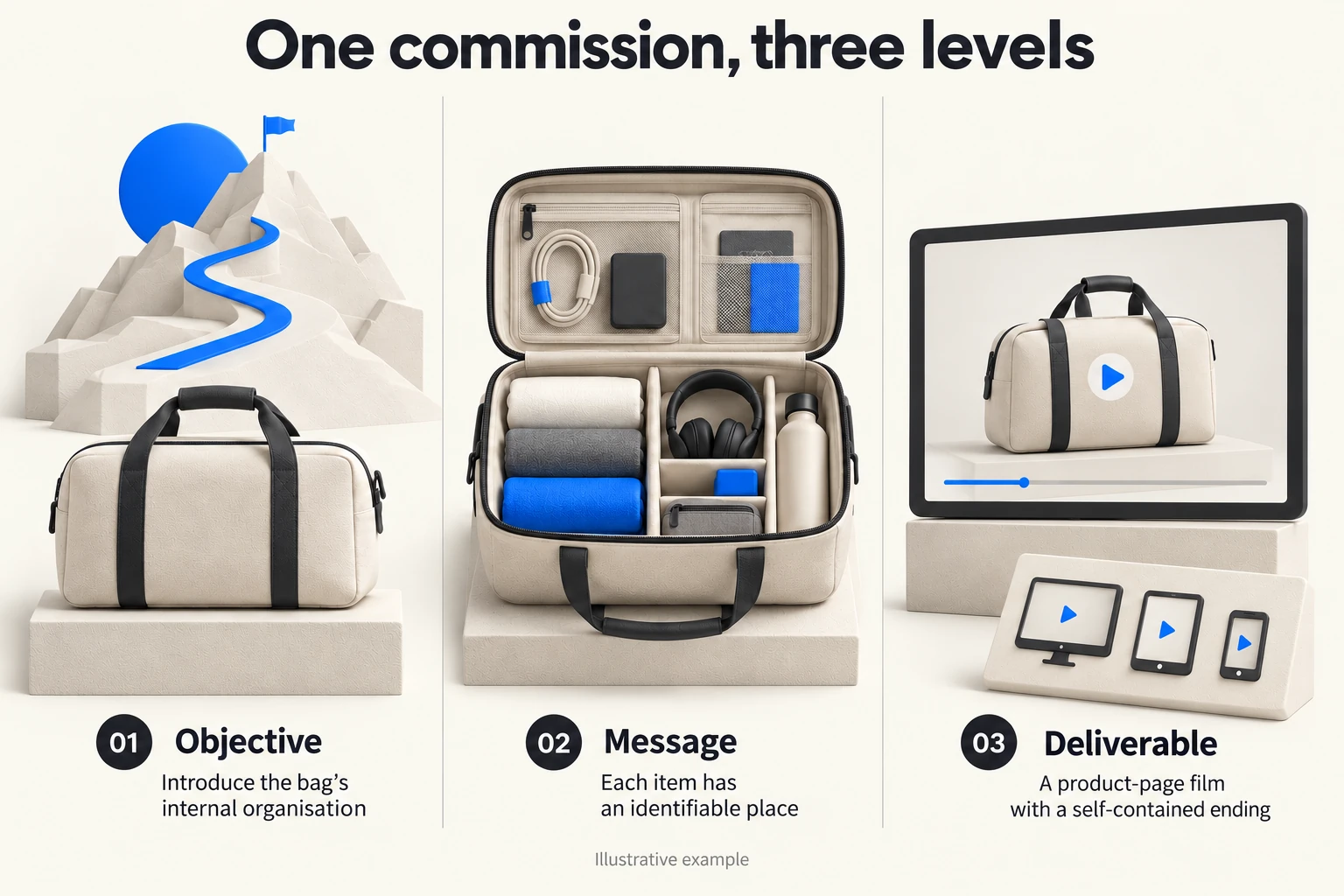
Fictional example: a compartmentalised travel bag
| Level | Example decision |
|---|---|
| Goal | Introduce the bag’s internal organisation |
| Message | Each item has an identifiable place |
| Deliverable | A product-page film with a self-contained ending |
Generated teaching maquette · Fictional example. Shapes and relationships illustrate the principle; they are not an optical simulation or a product test.
Three lines for a real film
For our Nothing spec film Le monde baisse (30 s, 9:16), an independent concept made without any commission from the brand, the three levels fitted on three lines.
- Goal: move the viewer from fragmented impressions of the headphones to a clear view of their form and materials.
- Message: all the attention goes to listening. The closing line puts it in French: « Le monde baisse. La musique reste. » (“The world turns down. The music stays.”)
- Deliverable: a 30-second vertical 9:16 film, cut to credited music (Twilight Echo by Scott Buckley, licensed CC BY 4.0), with a PIRAXE end card.
No line stands in for another. The format says nothing about the headphones. The goal does not say which sentence the audience should remember. And the message alone does not specify the length or the music to deliver.
The goal gives the commission a direction
For the rest of this guide, take a fictional brand launching a travel bag with several compartments. Its goal might be to introduce that internal organisation to people who already know its classic bags.
That sentence describes an intended change, not how to measure it. Evaluating a campaign needs its own method, separate from writing the script.
If your goal mixes awareness, detailed explanation and an immediate response to a promotion, rank those priorities. A film can carry several pieces of information, but the brief has to settle what wins when they compete for the same seconds.
The message names the understanding you want
For this bag, “every item has a place you can find” is one possible message. It might lead to a packing scene, an organised view of the contents or a moment where someone finds an object without rummaging.
Choosing this message already rules things out. A sequence of landscapes says “travel” without explaining the compartments: it might suit the brand’s mood, but not this message.
Ask a colleague to restate the message without looking at the feature list. If all they can repeat is a broad adjective such as “practical”, make the information more specific. It is a clarity check inside the team, nothing more.
The deliverable makes the commission checkable
“A video for the product page” is only a start. Add the intended length, versions, languages, subtitles and files you need. Where the film will be seen can also change how it is built.
For the bag, we would suggest a self-contained ending: the last shot makes sense without relying on a button elsewhere on the page. That is a choice to discuss with whoever runs the store.
Confirm dimensions and integration constraints with the person who will publish the file rather than guessing them from the channel name. Also tell apart a plain export of the same film from a version that needs a different opening or argument.
Follow one proposed scene through the brief
Suppose the first proposal for the bag shows someone arriving at a station, digging through the main compartment and finally finding a ticket in a separate pocket. The scene expresses the idea of a place for every item. It also raises a product question: does the real bag have that accessible pocket?
| Decision | Question to ask about this proposal | Possible response |
|---|---|---|
| Goal | Does the scene introduce the new organisation of the bag? | Yes, if the pocket is visible and its use is understood. |
| Message | Will the viewer see where the ticket was stored? | Not in the current draft: the retrieval happens below the frame. Rewrite that action. |
| Deliverable | Can this scene work in the planned product-page version? | Check the crop and surrounding copy with the publishing team. |
| Product accuracy | Is that pocket present on the model being sold? | Ask the product owner before approving the action. |
The rewrite shows the hand going into the right pocket before the ticket appears. No narrator needs to call the bag “practical”: the image does the job.
Resolve competing objectives before shortening the edit
A new request comes in: add a brand story at the start and a promotional price at the end. Ask which priority in the brief has changed. If explaining the compartments is still the main job, protect the retrieval action and consider whether the promotion belongs in a separate ending or version. If the goal is now to announce an offer, update the brief first, then judge the old story against the new task.
The decision fits in three lines: “For this version, understanding the pocket layout comes first. The brand story stays out of this edit. The promotional ending is waiting for approval.”
What else goes into a creative brief
Goal, message and deliverable are the core of the brief, not the whole of it. Add:
- the audience and the situation in which they will see the film;
- the product facts to respect and the claims you are allowed to make;
- your references, each with one sentence on what interests you;
- constraints: languages, mandatory wording, brand guidelines;
- the schedule, with the reason behind any fixed date;
- who approves, and at which stage.
The downloadable template in our e-commerce video brief guide covers these sections, with a filled example.
Use substitution to spot an unclear brief
Replace your product’s name with another one. If “make an attractive fifteen-second video” is still the whole instruction, you have described a deliverable, not a film. If the message could belong to any brand, tighten it.
Finally, put the three statements in a short table and have them approved together. Disagreements become easy to locate: teams often share the goal but not the message, or not the expected version.
Include these three decisions in your project brief, identifying the parts that still need to be developed.
Guide prepared by PIRAXE with the help of AI tools, based on the sources cited. Examples are illustrative, not client results.