


Planning and production
What is a shot list? Why you need one when the script is already written
A shot list is the numbered list of every shot a film needs, with its framing, action and length. It turns an approved script into images you can plan, price and discuss. That is exactly why it matters once the script exists: a script says what happens, not how the viewer will see it.
In this guide
Adobe calls the shot list a cheat sheet that makes sure the editor gets the coverage needed to cut a coherent story. Source: Adobe, How to make a shot list. In advertising it does one more job: it flags early what the product demands, whether that is a control to show, a label to keep legible or a vertical frame.
What goes into a shot list
One row per shot, with columns that answer the crew's questions:
- shot number and its job in the story;
- shot size (wide, medium, close-up…);
- what is visible when the action starts and ends;
- camera movement, if any;
- target duration;
- sound and on-screen text;
- product constraint: shape, label, control, exact colour.
Lens choices and production techniques can stay out of the brand conversation unless they change the result. A rough sketch, on the other hand, often explains a layout faster than a column of adjectives.
A real case: the coffee gestures in Les nuances du matin
For our spec film Les nuances du matin (illy, 9:16, about 38 seconds), the intention fit in one line: let the gestures tell the story. It is an independent concept, made without any commission from the brand. Written like that, the intention doesn't say what to film. So we made the phone, the beans, the machine and the cup the concrete steps of the story.
One shot shows a hand pouring beans from the illy tin into the machine's open hopper, beside a window. The gesture, the recognisable product and the result all sit in one frame. That is the idea behind shot L2 in the exercise below.
“She switches on the lamp” allows several different films
Now a fictional example, illustrated below. A brand wants to feature a reading lamp, and the script says: “She switches on the lamp and returns to her book.”
The whole action could stay in a frame wide enough to include the book, her face and the light. Or the film could isolate the control, then show the lit page. Both follow the sentence. They give very different weight to the gesture, the product and the person.
It comes down to what viewers need to understand. Where to press? The intimacy of a reading moment? How the light falls on the page? A tight shot of the switch answers the first question and spoils the second.
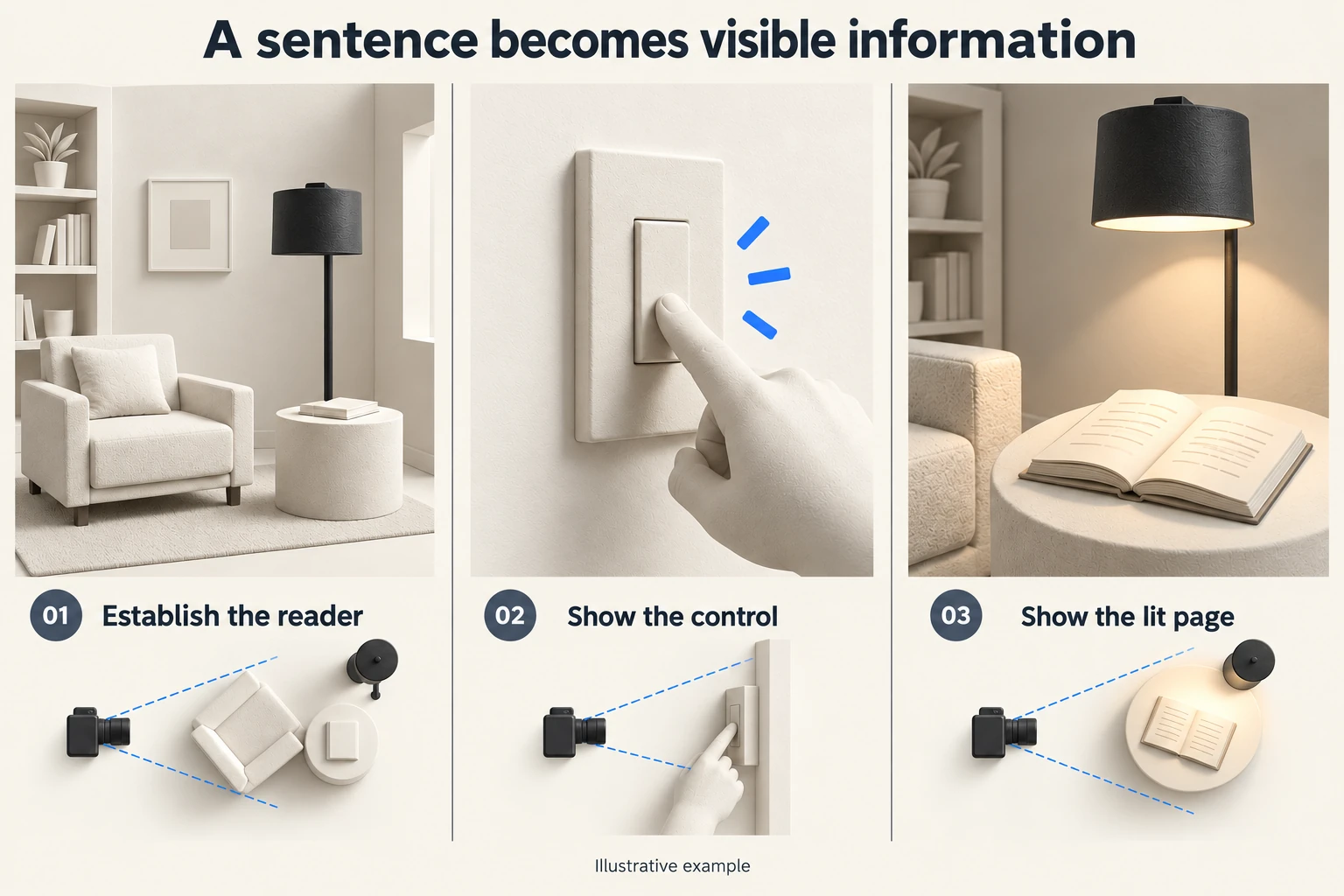
- Establish the reader
- See the control
- See the illuminated page
Generated teaching maquette · Fictional example. Shapes and relationships illustrate the principle; they are not an optical simulation or a product test.
Three shots are proposed here; one carefully composed shot could also contain these elements.
Compare two breakdowns of the scene
For a film about the pleasure of reading, one continuous side view is enough. The hand reaches the lamp, the light comes on and the reader returns to the page without a cut. The moment stays whole. The risk is the control: if it sits at the back of the base, nobody sees what the hand does.
To introduce an unfamiliar control, you need two shots. L1 establishes the reader, lamp and book. L2 puts the control and the lit page in the same frame, like the bean shot in the illy film, so the press and its effect read together.
The entry for L2 might look like this:
| Field | Proposed entry |
|---|---|
| Purpose | Show which control starts the reading light |
| First visible state | Lamp off; index finger approaching the confirmed control |
| Action | Finger presses once; light reaches the open page |
| Final state | Finger withdraws; light remains on; page stays in view |
| Product constraint | Use the supplied model's control position and shape |
| Link to L1 | Same hand, same page spread, lamp in the same place |
| Open question | Can both the control and the page remain readable in portrait framing? |
If the real lamp uses a rotary dimmer, the press has to change before the image is approved.
To adapt the entry to your product, replace the purpose and the start and end states first, then add only the constraints that change the image. “Cinematic, premium, elegant” tells nobody where the control is. A photo of the underside of the base does.
Give each shot a reason to stay
Take the control shot out in your head. If the operation stays obvious and the ad sells a mood, it can go. If the film has to explain an unfamiliar control, losing it leaves a hole.
Then flip the question: could one frame show the gesture and its effect without becoming unreadable? A twenty-line shot list is not better than an eight-line one.
When you approve the breakdown, ask to see the sequence in a form you can watch (storyboard or animatic) along with a list of the questions still open. A duration written next to a drawing is an intention until the movement has been seen in time. In our Production only offer we start from your script, and the shot list, camera language and animatic come to you for approval before production. That is where these questions get settled.
Guide prepared by PIRAXE with the help of AI tools, based on the sources cited. Examples are illustrative, not client results.