


From idea to script
Commercial treatment examples: what a director’s treatment decides
A commercial treatment, often called a director’s treatment, describes the film clearly enough to discuss the story, the tone and the product’s role before anyone plans individual shots. It usually does two jobs: it states the director’s intention (the point of view, the tone, the visual choices) and it tells the spot scene by scene, in prose. Below are two examples: a real two-sentence intention from one of our spec films, and a scene-level treatment revised after brand feedback.
In this guide
No Film School describes the agency-pitch version as a 5–12 page document that sets out the director’s vision within the agency’s brief, covering the story, the product, casting, gear and budget. StudioBinder defines a film treatment as a detailed summary written in prose that carries every important scene and the tone.
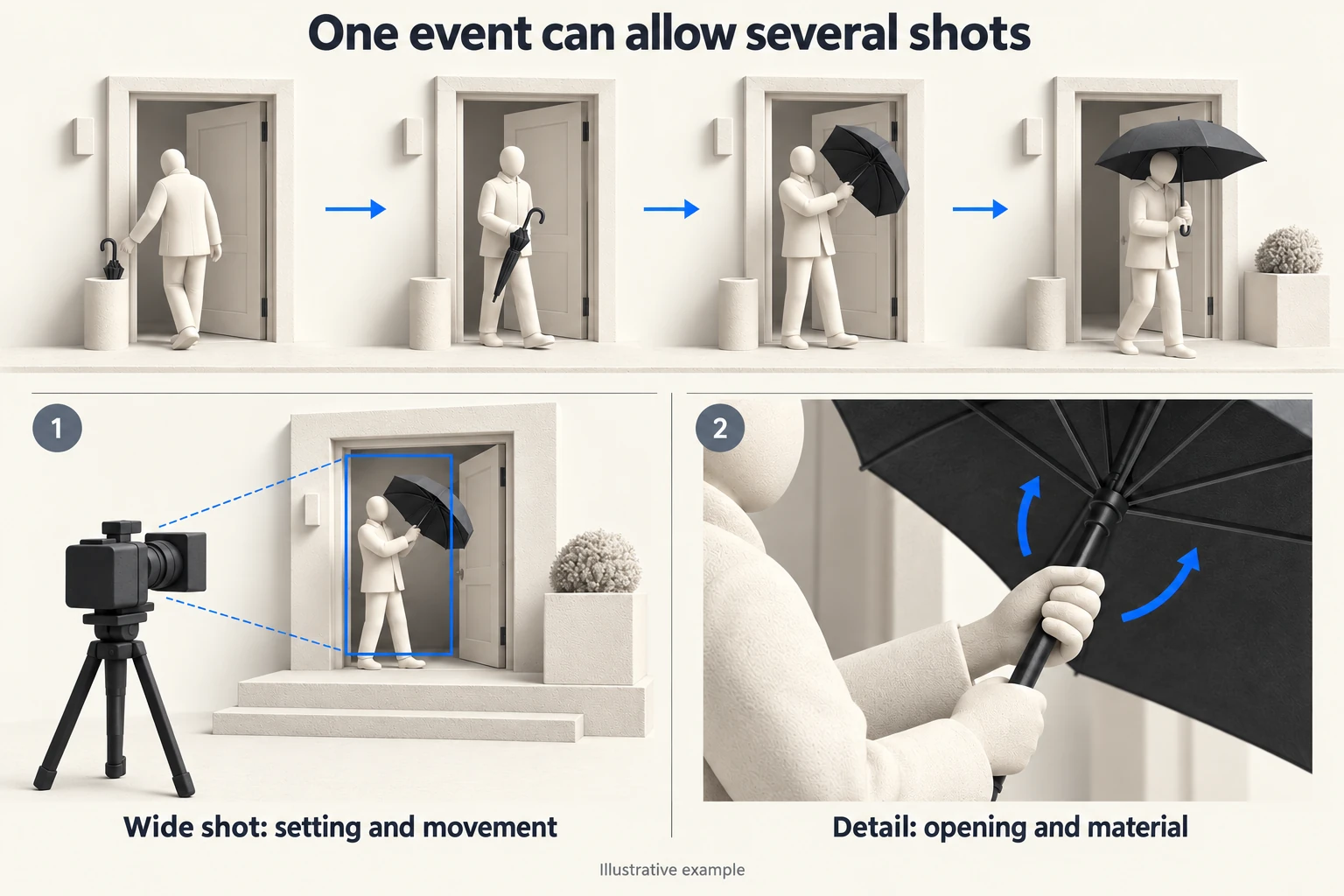
Illustrative treatment: a person opens an umbrella before stepping outside.
- Wide view: place and movement
- Detail: opening and material
Generated teaching maquette · Fictional example. Shapes and relationships illustrate the principle; they are not an optical simulation or a product test.
Intention vs treatment: what each part decides
| Intention (statement of intent) | Treatment | |
|---|---|---|
| Question | Why this film, and in what spirit? | What do we see, and in what order? |
| Content | A point of view, a tone, visual choices | The scene-by-scene progression, the sound, the product’s place |
| What the brand approves | A direction | A story |
| What it leaves to the shot list | Almost everything | Shot sizes, camera, timing |
French production keeps the intention as a separate short document, the note d’intention. At France’s national film centre (CNC), director Franck Dion calls it “a transitional support, a working tool that isn’t fixed” (our translation). For a 20- or 30-second film, a short intention and a one-page treatment are often enough to make the decisions that matter.
A real intention in two sentences: Earth / Light
For our spec film Earth / Light (Terre d’Hermès, 18 seconds, 9:16, an independent concept made without any commission from Hermès), the published intent is two sentences long: “Build a sensory world through imagery: low sunlight, mineral textures, translucent fragrance and warm contrasts. One setting, explored from close-up to product shot.”
Those two sentences decide a lot. A world (rock, low sun), a constraint (one setting) and a progression (from close-up to product shot). They don’t yet set the order of the shots.
You can see the move to a shot list in the film’s production choices: contrast raw rock with precise reflections in glass and metal; reveal the bottle behind a rock, then vary scale and viewpoint; close on a clear product shot with the PIRAXE signature and the SPEC AD label. Each choice can be traced to a phrase in the intent. “Mineral textures” gives the foreground rock, visible both in the composition reference and in the frame from the edit at 4.5 seconds. “From close-up to product shot” gives the ending.
A treatment example at the scale of one scene
For the treatment, take an umbrella, a product invented for this guide. A first version could read:
A person reaches the building’s doorway with a paper bag held against their coat. Rain splashes just beyond the shelter. They put the bag down beside their feet and open the umbrella. The room’s conversation fades behind them as the canopy fills the top of the frame. They pick up the bag, take a careful step outside and continue along the pavement. The umbrella stays above them as the doorway slips out of view. We end on the moving canopy and the product name.
There is a beginning, a progression and an ending. The choices are concrete: a dry doorway, an opening action, a shift in sound. A string of adjectives such as “elegant, emotional, immersive” would give the brand nothing comparable to discuss.
The passage doesn’t set the number of shots, the focal length or the camera movement. It also leaves a product question open: which opening action and handling match the real model? Note it beside the passage, so good writing doesn’t make anyone forget to check.
Finally, look at where the product sits. If it only arrives in the last sentence, ask whether that was intended or whether the writing simply left it out.
What can stay open
A treatment can leave several shot choices open. The diagram shows how: the same event can be told through a view of the person in the setting or a close detail of the opening.
Some decisions do belong in it, though. If the film depends on a reveal, say when the information becomes visible. If a line must stay word for word (a legal mention, a product range name), flag it. And if an alternative is still undecided, name it along with what changes between the options, instead of presenting two incompatible films as one direction.
The brand’s feedback, then the revision
The first version raises one issue: does the careful departure make the character seem hesitant, when the intended tone is assured? Useful feedback points to the passage: “Keep the contrast between the dry doorway and the rain. After the umbrella opens, the character should commit to leaving. The careful step makes the departure feel uncertain. Keep the weather ordinary; we are not demonstrating storm resistance.”
Two directions are now possible. A playful treatment would have the character open the umbrella with excessive ceremony, then realise the paper bag is still at their feet: it adds a small mistake and a recovery, so it changes the story. A composed treatment would have them prepare everything before opening it and leave in one movement: it changes the behaviour, not the progression. If the brand picks the composed direction:
At the doorway, a person moves the paper bag into one hand and takes the umbrella in the other. Rain crosses the pavement in front of them. They open the canopy, check its position with a brief upward glance and step out without pausing. The building’s conversation gives way to the sound of rain. Their pace stays even as the doorway disappears behind them. The final view holds the umbrella’s shape as it moves through the ordinary street; the product name appears once the action is clear.
The umbrella does nothing it didn’t do before. Only the character’s preparation and pace have changed.
Hand over the decisions the revision settles
The handover note can now say: “Approved direction: composed departure. Keep the doorway-to-rain sound change. No comic forgotten-bag beat, no exceptional weather. Open decisions: shot sizes, camera path, exact timing and placement of the final name.”
That leaves the shot list its own questions. If a later camera proposal makes the character look hesitant, go back to this performance intention before turning the disagreement into a debate about lenses. When you comment on a treatment, keep the same order: the progression first (the scene, the product’s role, the ending), then tone, then shot preferences. When we develop a film for a brand, this is the stage where you approve the story, before the shot list and the animatic.
Introduce an existing treatment in an AI production brief, or identify the decisions that still need to be developed.
Guide prepared by PIRAXE with the help of AI tools, based on the sources cited. Examples are illustrative, not client results.